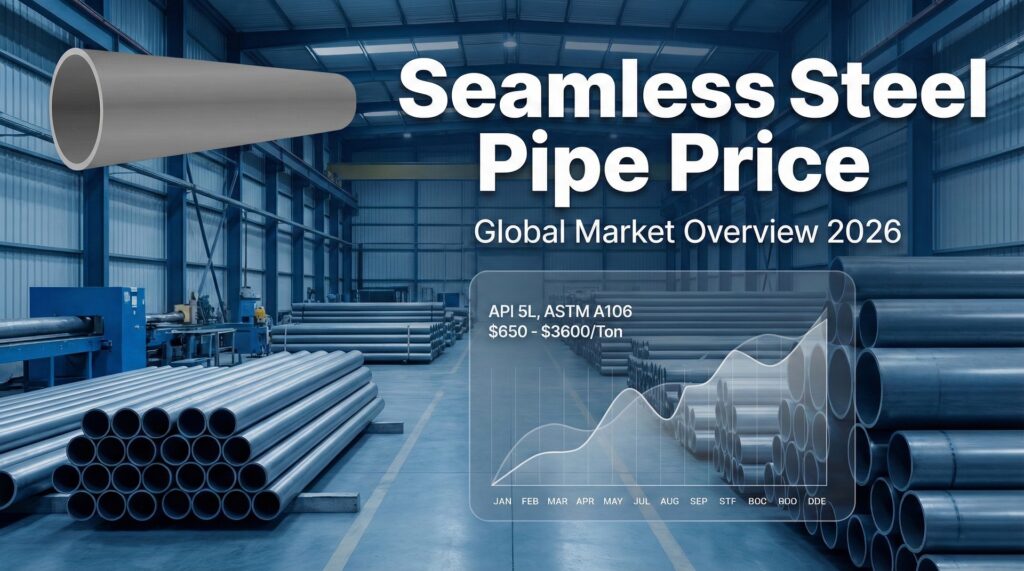
Seamless steel pipe is one of the most important materials in modern industry, especially in projects where high pressure, high temperature and absolute reliability are required. Unlike welded pipes, seamless steel pipe is produced without any longitudinal or spiral weld seam. This weldless structure provides homogeneous mechanical properties around the entire circumference of the pipe and makes seamless steel pipe a preferred choice in refineries, power plants, petrochemical facilities, hydraulic systems and many other critical applications.
How Seamless Steel Pipe Is Produced
The production of seamless steel pipe starts with a solid steel billet. This billet is heated to a high temperature and then pierced using a mandrel or plug, creating a hollow tube. After this stage, the tube is elongated, rolled and sometimes cold-drawn until the required diameter and wall thickness are obtained. Because there is no welded joint, the body of the seamless steel pipe maintains a continuous structure, which is a major advantage under high internal pressure and fluctuating loads.
Hot-finished seamless steel pipe is suitable for many pressure and mechanical applications, while cold-drawn seamless steel pipe offers better dimensional tolerances, surface finish and roundness. For this reason, cold-drawn seamless steel pipe is widely used in hydraulic systems, precision machinery, automotive components and instrumentation lines where accuracy is essential.
Key Properties of Seamless Steel Pipe
One of the main properties of seamless steel pipe is its ability to withstand high pressure. Because there is no weld seam, the risk of weld-related defects such as lack of fusion, porosity or slag inclusion is eliminated. This makes seamless steel pipe ideal for high-pressure steam lines, boiler tubes, hydraulic circuits and process lines in the oil and gas industry. In addition, seamless steel pipe can be produced in a wide range of diameters and wall thicknesses, offering design flexibility for engineers.
Another important property is the excellent performance of seamless steel pipe under high temperature conditions. Alloyed seamless grades are used for boiler tubes, superheater coils and high-temperature steam lines where creep resistance and microstructural stability must be guaranteed over long service periods. For low-temperature or cryogenic applications, special seamless steel pipe grades with high impact toughness prevent brittle fracture and provide safe operation even at sub-zero temperatures.
Common Usage Areas of Seamless Steel Pipe
Seamless steel pipe is used across many sectors. In the oil and gas industry, it is preferred for casing, tubing, flowlines, manifolds and high-pressure process lines. In refineries and petrochemical plants, seamless steel pipe carries high-temperature and high-pressure fluids, steam and aggressive chemicals between process units. The homogeneous structure of seamless steel pipe helps maintain safety and reduces the risk of leakage in these critical applications.
In the energy sector, seamless steel pipe is widely used in power plants for boiler tubes, heat exchangers, superheaters, reheaters and feedwater systems. Heat transfer and pressure resistance are vital in these components, and seamless construction provides a solid foundation for long-term reliability. In addition, seamless steel pipe is used in district heating networks, combined-cycle plants and various auxiliary systems such as lube oil and instrument air lines.
Outside of process and energy applications, seamless steel pipe is also important in mechanical engineering and the automotive industry. It is used in drive shafts, axles, cylinders, structural components and precision mechanical parts. Because seamless steel pipe can be machined into complex shapes with consistent wall thickness and concentricity, it offers both performance and cost advantages to manufacturers.
Advantages of Seamless Steel Pipe Over Welded Pipe
When comparing seamless steel pipe with welded pipe, several advantages become clear. The most obvious is the absence of a weld seam, which removes a potential weak point in the pipeline. This is especially important in systems subject to pressure cycles, vibration and thermal expansion. Seamless steel pipe also provides more uniform mechanical properties, reducing the risk of unexpected failures.
In many cases, seamless steel pipe offers better dimensional accuracy and surface quality than welded alternatives. This simplifies installation, improves sealing performance at connections and reduces the need for rework in the field. For high-pressure systems, seamless steel pipe can often achieve higher allowable stress values in design calculations, enabling more compact and efficient piping layouts.
Quality Control and Testing of Seamless Steel Pipe
To ensure safety and reliability, seamless steel pipe undergoes strict quality control and testing. Mechanical tests such as tensile testing, hardness measurement and impact testing verify that the pipe meets the required strength and toughness values. Non-destructive tests like ultrasonic or eddy current inspection are used to detect internal defects and verify wall thickness consistency.
Hydrostatic testing is commonly applied to seamless steel pipe to prove its ability to withstand specified internal pressure levels. Dimensional checks confirm that diameter, wall thickness, straightness and ovality remain within the tolerances set by international standards and customer specifications. Together, these quality control steps provide confidence that each length of seamless steel pipe is suitable for installation in critical systems.
Choosing the Right Seamless Steel Pipe for Your Project
Selecting the correct seamless steel pipe for a project involves evaluating design pressure, temperature, fluid type, corrosion conditions, mechanical loads and applicable standards. The choice of steel grade and wall thickness must reflect these factors, and coating or lining systems may be required for corrosive environments. Working with an experienced supplier of seamless steel pipe helps ensure that all these parameters are considered and that the final solution delivers both safety and cost efficiency.
In summary, seamless steel pipe offers a unique combination of strength, reliability and flexibility that makes it indispensable in many sectors. Its weldless construction, high pressure and temperature resistance, wide dimensional range and proven performance in critical applications explain why seamless steel pipe continues to be the preferred material for high-specification piping systems worldwide.